

Night-time and anxiety have an uncomfortable relationship. During the day, there’s usually enough going on to keep the worst of it at bay. But at night, when everything goes quiet, and there’s nothing left to distract you, the thoughts that have been waiting patiently all day tend to surface.
For me, it’s mostly money and work stress – the unpredictable nature of being self-employed means there are periods where financial worry follows me to bed. On those nights, falling asleep is harder, and I wake more easily than usual.
Occasionally, I’ll wake in the night with that familiar flutter of anxiety in my chest and no obvious reason for it. If that sounds familiar, my post on natural remedies for anxiety covers the broader picture of what helps day to day.
My sleep is generally good – I have a consistent routine, a calm bedroom, and I’ve found what works for me. But it took some trial and error, and the thing that works best for me isn’t what most sleep articles recommend.
Here’s what actually helps.
Create a proper wind-down routine
The single most effective thing I’ve done for sleep is having a consistent routine that signals to my brain that the day is ending. Not a rigid checklist, just a sequence of familiar things that happen in roughly the same order each night.
For me that means wrapping up work, spending some time with Ben talking through the day, getting into night clothes, switching to lamps rather than overhead lights, brushing teeth, and then watching something from bed before sleep.
These small signals – the dimmer light, the comfortable clothes, the familiar sequence – tell your brain the day is ending even before you’ve consciously decided to wind down.
I’ll also be honest about something else that goes against conventional advice: I often work on my laptop in bed in the evenings. I know that’s not what the sleep experts recommend. But the key for me is that I always close the laptop and watch at least 30 minutes of TV from bed before actually trying to sleep.
That transition – from work mode to passive watching – is what matters. The screen itself isn’t the problem for me; it’s whether my brain has had a chance to shift gears before I close my eyes.
Watch something genuinely engaging
This goes against standard sleep advice, and I’m sharing it anyway because it’s honestly what works for me.
I work right up until bedtime most nights. My brain is active, my thoughts are running, and if I lie down in the dark and silence immediately, my mind fills with whatever it was working on – or worse, whatever I’m worried about. That’s not a recipe for sleep.
What works for me is watching something that requires enough attention to fully occupy my mind. It has to be genuinely engaging – if it’s not interesting enough, my thoughts will wander straight back to work or money or whatever I was trying to escape.
But when I’m properly absorbed in something, there’s no room for anxious thoughts to creep in. By the time it ends, my mind has had a chance to reset, and sleep comes much more easily.
The one downside – and I’ll be honest about this too – is that when a series is really good, I can’t stop at one episode. I end up watching one or two more than planned and going to bed much later than intended.
So it works brilliantly for switching off, but requires a bit of willpower to actually stop watching. Something to bear in mind!
This won’t work for everyone. If screens genuinely wire you up or disrupt your sleep, skip this one. But if you’re someone who finds silence activates your thoughts rather than calms them, replacing it with something absorbing might help more than you’d expect.
Make your bedroom a genuinely restful space
Your bedroom environment matters more than most people realise. Ours is calm, simply decorated, and set up specifically for sleep.
We have blackout blinds, which make a real difference – especially in summer when it stays light late. A comfortable mattress and good bedding are worth investing in; you spend a third of your life there. And I always have a glass of distilled water on my bedside table, so I’m not getting up in the night if I wake thirsty.
The general principle is removing anything from the bedroom that creates mental noise – work, clutter, bright lights, or anything that reminds your brain it needs to be alert. A calm room helps create a calm mind.
Breathe through it if you wake anxious
On the nights I wake up with anxiety – that unexplained feeling that something is wrong even when nothing is – breathing is the fastest way back to calm.
What I do is simple: breathe in as slowly and as deeply as I can, then breathe out as slowly and as fully as I can. No counting method, no complicated technique.
Just making each breath as long and controlled as possible. It works by interrupting the physical stress response – slowing your heart rate and signalling to your nervous system that you’re safe.
If you wake in the night and your mind immediately starts churning through worries, don’t engage with the thoughts. Focus entirely on your breath instead. It sounds too simple but it genuinely shifts something.
Talk through whatever is worrying you
For money and work anxiety specifically, one of the most effective things I do is talk to Ben before bed. Not to solve anything – usually there’s nothing to solve at that point – but just to say out loud what’s on my mind.
There’s something about externalising a worry that reduces its power. When it’s just circling in your head it can feel enormous. Said out loud to someone who listens, it often becomes more manageable.
And if it’s a shared concern – finances, something with the kids, a decision that needs making – at least you’re carrying it together rather than alone. My post on ways to reduce stress and anxiety has more on this if stress is a persistent pattern for you.
If you don’t have someone to talk to, even writing worries down before bed can help. Getting them out of your head and onto paper creates a similar effect – you’re acknowledging them rather than suppressing them, which paradoxically makes them easier to set aside.
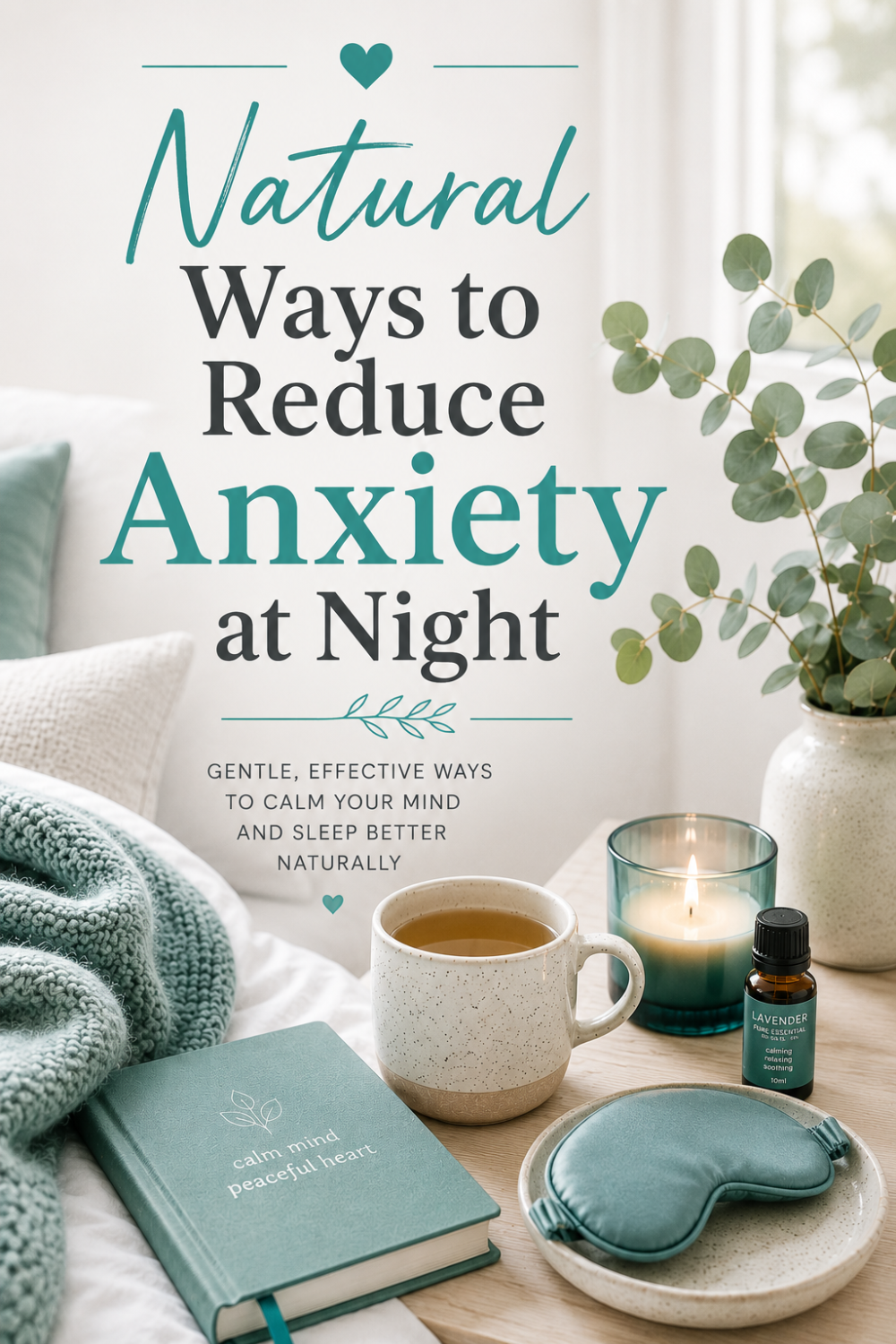
Herbal teas and calming scents
A warm herbal tea in the evening is a genuinely useful part of a wind-down routine – as much for the ritual as for the herbs themselves. Chamomile is the classic choice and many people swear by it, though it’s not personally my favourite.
I prefer berry flavours and night-time blends, or a lemon herbal tea – something warming and naturally sweet that feels like a treat rather than medicine. Whatever flavour works for you, the act of making something warm, sitting quietly, and drinking it slowly has its own calming effect.
I also use essential oils in the evening when I remember – lavender in the diffuser is a particular favourite, and frankincense is good for a grounding, quietening effect before bed.
If I’m honest, I don’t always remember to put the diffusers on, but when I do it makes a noticeable difference to the atmosphere in the room.
Sometimes we light a soy candle with natural fragrances instead, which gives a similar effect – warm light, a gentle scent, something that signals the evening is winding down. Both are easy, low-effort ways to make your environment feel calmer without any real effort.
Keep a consistent sleep schedule
Going to bed and waking at roughly the same time every day – including weekends – is one of the most evidence-backed things you can do for sleep quality. Your body clock responds to consistency, and disrupting it regularly makes it harder to fall asleep and wake feeling rested.
My post on getting a good night’s sleep and waking up refreshed goes into more depth on this.
I’m generally consistent with this and I think it makes a real difference. It doesn’t have to be rigid – within an hour or so either way is fine – but the more consistent you are, the more your body learns when it’s time to sleep.
What to do when worry keeps you awake
On nights when money or work stress is genuinely keeping me awake, the most useful thing I’ve found is to acknowledge the worry rather than fight it. Trying to force yourself not to think about something rarely works – it tends to have the opposite effect.
Instead, tell yourself: I hear this worry, I’m not ignoring it, but there is nothing I can do about it right now. Tomorrow I can look at the spreadsheet, make the call, take the action. Tonight, the only useful thing is sleep.
Then redirect to your breath, or back to whatever you were watching. It doesn’t always work immediately, but it works better than lying there trying to solve an unsolvable problem at midnight. For more specific techniques, my post on sleep hygiene and wellbeing is worth a read.
Discover more from Healthy Vix
Subscribe to get the latest posts sent to your email.