
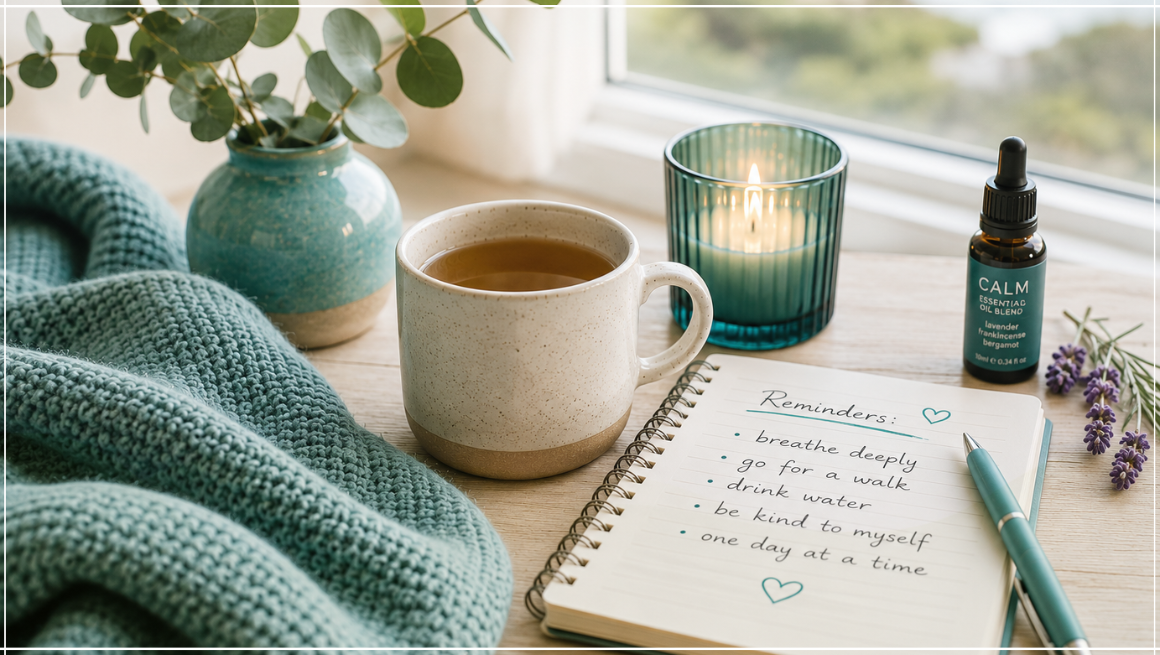
I experience anxiety regularly. It’s not something I’ve always been open about, but it’s true – and I think being honest about it makes anything I share on this topic more useful than a generic list of tips written by someone who isn’t living it.
My anxiety comes and goes in phases. It’s worse in winter, worse when work is unpredictable (which, as someone self-employed, is fairly often), and tends to spike around specific situations rather than being a constant low hum.
Social anxiety is probably the hardest part – it’s the one area where I genuinely struggle to overcome it no matter what I try. Sometimes you just have to get through things. Sometimes even that doesn’t make it better.
What I’ve found over the years is that there’s no single fix. Different things work for different triggers, and some days nothing works at all.
Sometimes I don’t even know what I’m anxious about. It’s like a flutter of butterflies in my chest and belly that won’t settle – a constant low-level worry with no obvious cause. A tickle I can’t get rid of. A strange feeling that something is wrong, even when nothing is. That kind of anxiety is the hardest to address because there’s nothing to act on. All you can do is ride it out and use whatever tools take the edge off.
But there are natural approaches that consistently help me more than others – and those are what I want to share here.
Get outside and move your body
This is the one that works most reliably for me, and the research backs it up. Exercise and walking are my go-to natural remedies for anxiety – not because they cure it, but because they reliably take the edge off.
There’s something about being outside in nature specifically that helps beyond just the movement. Fresh air, natural light, green space – it shifts something. Even a short walk can interrupt an anxious thought spiral in a way that sitting inside trying to think your way out of it simply can’t.
On difficult days, getting outside is often the last thing I want to do. But it’s almost always worth it. If you can combine walking with nature – woodland, coast, countryside – even better.
My post on how walking keeps you healthy and active covers more on the physical and mental benefits of making it a regular habit.
Breathe through it
Breathing techniques are another one that genuinely works for me, particularly in the moment when anxiety is spiking. When we’re anxious, our breathing tends to become shallow and fast, which actually reinforces the body’s stress response and makes things worse.
Slowing your breath down deliberately interrupts that cycle. I do a 6-6-6 method! Inhale for 6 seconds, hold for 6, exhale for 6. It feels a bit awkward at first, but it becomes more natural with practice.
Even just taking slow, deliberate deep breaths for a minute or two can make a noticeable difference.
This is one of the few techniques that works in social situations too, where other remedies aren’t practical. You can do it quietly without anyone noticing.
Talk about it
This sounds obvious, but talking to someone you trust about anxiety genuinely helps – not because it solves anything, but because anxiety often feeds on being kept inside. Saying things out loud, even to just one person, can take away some of their power.
My husband is my first port of call. He doesn’t always have answers, and I’m not always looking for them – sometimes I just need to say what’s worrying me rather than letting it loop around in my head.
For money anxiety in particular, talking through where we actually are financially tends to be more useful than sitting alone with the worry.
If you don’t have someone you feel comfortable talking to, it’s worth considering whether a professional might help. I’ve written honestly about my own experience with talking therapy – it isn’t always the right answer for everyone, but for some people it’s genuinely valuable.
Try to act on it where you can
One thing I’ve learned is that some anxiety is actually useful – it’s pointing at something that needs addressing. Money worry, an unresolved situation, a decision that needs making. When anxiety has a real cause, the most effective remedy is often to do something about it, even something small.
Making a plan, taking one action, getting clarity on a situation – these things can reduce anxiety more effectively than any herbal remedy. It’s worth asking yourself whether the anxiety is pointing at something actionable before reaching for the coping tools.
That said, not all anxiety has a clear cause or solution, and plenty of it doesn’t respond to logic at all. That’s when the other approaches matter more.
Herbal teas, supplements and CBD
I do use herbal teas, particularly in the evenings, and they’re a gentle support rather than a cure. Chamomile is the most well-known for relaxation, though it’s not my favourite favour! Lemon balm and peppermint are others worth trying. I prefer berry flavours, lemon too.
Beyond teas, I’ve tried various supplements over the years with mixed results. Ashwagandha is one I’ve come back to – it has reasonable evidence behind it as an adaptogen that helps the body manage stress, and I’ve noticed a difference when taking it consistently. Agnus castus is another I used for a while, particularly helpful for hormonal anxiety – though I’ve since stopped taking it.
CBD is the one that I think has made the most noticeable difference for me, particularly in winter when my mood and anxiety tend to be at their worst. I’ve tried CBD gummies, CBD oil, and CBD drinks at various points, and while it gets expensive to maintain, I do find it genuinely calming rather than just a placebo. It takes the edge off without making you feel foggy or medicated.
It’s worth noting that perimenopause can significantly heighten anxiety and emotional sensitivity – something I’ve experienced firsthand and written about honestly in my perimenopause article. If your anxiety has worsened in your mid to late 30s or 40s, you’re female, and you can’t quite explain why, hormones may be a factor worth exploring.
The honest downside to supplements is cost. When you’re buying good-quality CBD, ashwagandha, and other supplements regularly, it adds up quickly. I tend to use them in phases rather than permanently – particularly through winter – and focus on the free remedies like walking and breathing the rest of the time.
Essential oils and aromatherapy
I use essential oils at home and find certain scents genuinely calming. Lavender is the obvious one – it’s well researched for relaxation. I use it in a diffuser in the evenings and occasionally as a pillow spray. I also have it as a hand sanitising spray, and it’s good to spritz my hands every now and then and just smell them for a while, breathing it in!
I have many blends, such as relaxation and calming blends of oils, ready to pop in my diffusers to enjoy the scents at any time. I use water difuusers and they are quick and easy to set up.
Frankincense is another I come back to for a grounding, settling feeling. It’s one of my favourite scents!
I have two diffusers, one upstairs, one downstairs. I also burn incense sticks made from natural essential oils and herbs – nag champa being my favourite calming fragrance.
The science on aromatherapy for anxiety is modest, but scent has a direct connection to the emotional centres of the brain, which is why certain smells can shift your mood quickly. It’s not a remedy for serious anxiety, but as one tool among many, it’s easy, pleasant, and low risk. And a natural, non-toxic way to scent your home, too, if you use diffusers.
Eat well and stay hydrated
I won’t claim that diet cured my anxiety – it hasn’t. But eating well consistently probably supports a more stable baseline. Blood sugar crashes can contribute to irritability and low mood, and certain nutrients – magnesium, B vitamins, omega-3s – do play a role in nervous system function.
My post on mood-boosting foods goes into more detail on what to eat to support mental wellbeing. The short version is: plenty of vegetables, whole grains, healthy fats, and staying well hydrated all help. Cutting back on caffeine and sugar can make a difference too, particularly if you notice anxiety spiking after coffee.
Try to rationalise it – with realistic expectations
I do try to rationalise anxious thoughts – to step back and ask whether the thing I’m worried about is as likely or as bad as it feels. Sometimes this helps. It works best when the anxiety is attached to something specific and the thought spiral is doing its worst.
But I want to be honest here – it doesn’t always work, and with social anxiety in particular, rationalising rarely touches the sides. Knowing logically that a situation is fine doesn’t always stop your body from responding as if it isn’t. So this is a useful tool, but not a universal one.
Limit what you expose yourself to
Anxiety has triggers, and knowing yours matters. For some, watching upsetting news, spending too long on social media, or staying in situations that consistently make you feel bad all feed anxiety rather than help it. Reducing exposure to those things – not as avoidance, but as sensible boundary-setting – is a legitimate part of managing it.
This is different from avoiding everything that makes you anxious, which tends to make anxiety worse over time. It’s more about being honest with yourself about what’s adding to your stress load unnecessarily.
Social anxiety – what actually helps and what doesn’t
Social anxiety deserves its own section because it’s a different beast to other types of anxiety, and the standard advice often doesn’t touch it.
For me, social anxiety shows up in a few specific ways. Meeting new people sometimes makes me sweat – genuinely, visibly sweat, to the point where I worry about leaving a sweat mark on a chair when I stand up. It’s embarrassing in itself and adds another layer of self-consciousness on top of the anxiety that caused it.
Around some people I go completely quiet and can’t find myself at all. Around others I talk too much and interrupt constantly, which I then replay and cringe over for days afterwards. Sometimes weeks. I’ll revisit a conversation I had and analyse everything I said, everything I should have said, everything that might have come across wrong.
I also have what I’m fairly certain is rejection sensitivity – taking cancellations personally, wanting a small number of deeply loyal friends rather than lots of loose connections, finding it hard not to read into things. Time is precious to me, and being let down or cancelled on feels disproportionately difficult. Even with close friends I can worry before meeting up – what will we talk about, will I say something stupid, will I come across well. And then afterwards the replaying starts all over again.
I suspect a lot of this is connected to undiagnosed ADHD. Rejection sensitive dysphoria is strongly associated with ADHD and is significantly underdiagnosed in women – it can look a lot like social anxiety or just being “too sensitive”, when actually there’s something more specific going on. I haven’t been formally diagnosed, but the more I’ve read about it the more it resonates.
Social events are the hardest – weddings, parties, gatherings where I don’t know everyone. Any situation where I might have to talk to people I don’t know well, make conversation on the spot, or be “on” for hours. I can’t naturally think of what to say in the moment. I feel socially awkward and would far rather just meet close friends one to one with no one else around.
If I’m honest, I wonder sometimes whether I’ve made myself almost friendless on purpose – keeping my circle so small that I rarely get invited to things, and therefore rarely have to face the anxiety those situations bring. It works as a coping mechanism. But it also means I feel incredibly lonely a lot of the time. That push and pull – avoiding the thing that also makes you lonely – is one of the harder parts of living with social anxiety that doesn’t get talked about enough.
It extends to messages too. My stomach rolls when I get a text, a WhatsApp, a phone call – even from people I love. I dread looking. Replying takes so much more effort than it probably should – I reread and rewrite and second-guess even a simple catch-up message until it feels right. It’s genuinely stressful sometimes. I’d often rather just meet someone in person than exchange messages back and forth, which is ironic given that face to face brings its own anxiety too. There’s no easy option when your nervous system treats most communication as a potential threat.
What has genuinely helped most is simply structuring my life around it rather than constantly fighting it. I work for myself, by myself – which means I don’t have to navigate office dynamics or constant social interaction every day. That’s not fixing social anxiety, but it does mean it has less opportunity to cause damage on a daily basis. There’s nothing wrong with designing a life that works with your personality rather than against it.
The deep breathing helps in the moment. Preparing mentally before social situations – knowing what I might talk about, having a rough plan – takes the edge off. And being honest with myself that some situations will just be hard, and that’s okay, is more useful than pressuring myself to overcome something that may simply be part of how I’m wired.
Accept that some anxiety isn’t fixable right now
Social anxiety is the one I find hardest. There are situations where I just can’t overcome it, no matter what I try. Sometimes the most honest thing I can tell you is that you get through it – and sometimes even getting through it doesn’t make it easier next time.
That’s okay. Managing anxiety isn’t always about eliminating it. Sometimes it’s about reducing it enough to function, being kind to yourself on the days it wins, and keeping the habits in place that give you the best chance on better days.
For more on managing anxiety and stress day to day, my post on ways to reduce stress and anxiety is worth a read alongside this one.
Discover more from Healthy Vix
Subscribe to get the latest posts sent to your email.