
Losing someone you love is one of the hardest things life asks of us. And in the aftermath of that loss, the need to hold onto them – to keep some part of them present – is one of the most natural things in the world.
I’ve lost more people than I’d like to count, including my cousin and one of my closest friends, who died suddenly at 17 from a blood clot. Friends lost in their late teens – one in a car crash, another to a heart condition in their sleep. Eventually expected as they become elderly, but still just as sad, grandparents and great-grandparents, including my grandad, who I was particularly close to. A mother-in-law taken too soon by cancer in her early 60s. And in recent years, when in our 30s, my husband lost his best friend, who took his own life.
I’ve been to more funerals than weddings. And sadly, more of those funerals have been for young people or people who died before their time than for those who reached old age. Each loss has been different. Each person deserved to be remembered differently. And over the years, I’ve found that the act of doing something – creating something, marking something – is one of the most healing parts of grief, particularly for those you are most close to.
Here are some of the most meaningful ways to remember a loved one, including things I’ve done myself.
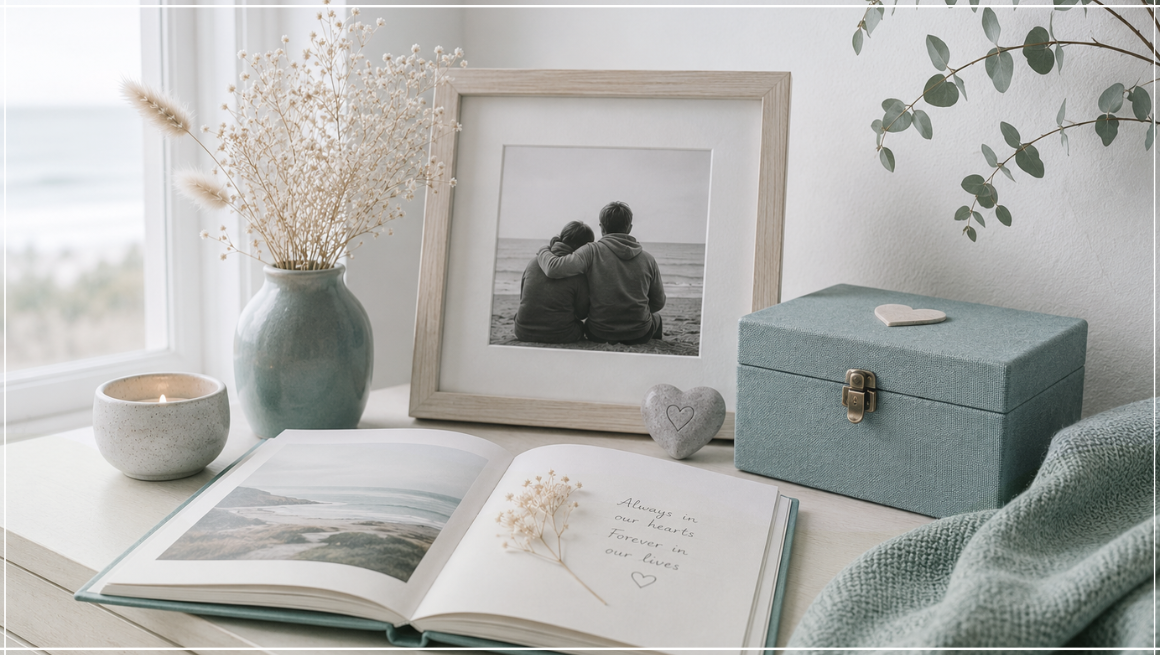
Create a photobook or memory box
This is the one I come back to again and again, and it’s the one that has meant the most to me personally.
When my cousin died, I made a photobook filled with photos of us together, letters, and keepsakes – things that captured who she was and what we meant to each other. I still have it. When friends died around the same time, I put photos and small mementos into a memory box that I’ve kept ever since.
When my husband lost his best friend, one of the first things he did was gather every photo he could find of them together and create a photobook online – annotated with where they were, what the occasion was, what that moment meant. He did it almost immediately, while the memories were sharp and the need to do something with his grief was urgent. That book is one of the most precious things he owns.
A photobook or memory box costs very little but holds everything. It’s something you can return to when you need it, and something that gets more valuable with time, not less.
Make a canvas or piece of art
When my cousin died at 17, I made a large canvas covered with photos of us together, decorated with beads and embellishments. I was 16 and it was the only way I knew how to process it – making something with my hands, creating something that felt worthy of how much she meant to me.
Art doesn’t have to be professional or polished to be meaningful. Painting a rock with someone’s name, creating a collage, making a scrapbook, carving initials into wood – any of these can be a way of channelling grief into something lasting. If you have artistic skill, sketching or painting a portrait of your loved one is a deeply personal tribute. If you don’t, the intention matters far more than the result.
Display their photos somewhere meaningful
My favourite photo of my grandad is from when I was little. There’s another from the last time we saw each other. Both are in my office, where I see them every day. Not as a source of sadness, but as a quiet presence – a reminder of someone I loved and who loved me.
Choosing a favourite photo, framing it, and putting it somewhere you’ll see it regularly is one of the simplest and most enduring ways to keep someone with you. A photo collage on a wall, a framed print in a meaningful spot, or even a personalised item like a mug or phone case with a favourite image – these small choices matter.
Donate to a charity in their memory
If your loved one supported a particular cause, or if a charity helped them during their illness, donating in their memory is a way of honouring who they were and extending the good they did in the world.
You can set up a tribute fund or donation page and share it with friends and family, mention it on funeral stationery, or simply make a quiet personal donation. Some people set up a monthly direct debit in their loved one’s name, keeping that connection alive long after the funeral.
Holding a fundraising event in their memory – a walk, a bake sale, something they would have enjoyed – is also a way of bringing people together around the person you’ve lost.
Do something they loved
Is there something your loved one was passionate about that you never tried? A hobby, a walk they always talked about, a recipe they were known for? Doing those things – really doing them, not just thinking about them – can be a powerful way to feel close to someone who has gone.
Go to their favourite restaurant. Cook their signature dish and serve it to people who knew them. Walk the route they loved. Visit the place that meant something to them. These aren’t just acts of remembrance – they’re a way of understanding them more fully, even after they’re gone.
Create something from their belongings
Some of the most meaningful tributes involve transforming something that belonged to your loved one into something new. A patchwork blanket made from their favourite clothing. A cushion from a beloved shirt. A teddy bear made from a coat they always wore.
These objects carry a physical connection that photographs alone can’t replicate – the texture of something they touched, the pattern of something they chose. Having something made from their belongings is a gift you can hold.
Remember them through nature
Planting a tree in someone’s memory, dedicating a bench, naming a star, or creating a new plant variety in their honour are ways of marking their absence in the natural world – something that grows and continues beyond the loss.
My cousin’s other grandmother had a sweet pea named in my cousin’s memory – something that blooms every year and carries her name forward. There’s also a plaque and some bushes planted in a park near where she used to live, a place people can visit and remember her.
My husband’s grandparents are remembered on a bench in Cornwall, in the last area where they lived, overlooking the sea. It’s exactly the kind of place they would have loved, and knowing it’s there – that their names are on it, that people sit there and look out at the same view – means something.
These tributes in nature have a permanence that feels right for grief. They don’t fade. They become part of a place, and visiting them on significant dates – birthdays, anniversaries – can become its own quiet ritual of remembrance.
Write to them
Writing a letter to someone who has died is something grief counsellors often suggest, and for good reason. It creates space to say what wasn’t said, to update them on your life, to process emotions that have nowhere else to go. When my cousin died, I wrote her a letter and sealed it. I still have it. I’ve never opened it, and I’m not sure I ever will – but writing it mattered. It was somewhere to put everything I couldn’t say out loud.
No one has to read it. You can seal it, burn it, save it in a box – whatever feels right. Just the act of writing can be enough.
A poem or a song, if words come naturally to you, can serve the same purpose. Not for anyone else, necessarily. Just for you, and for them.
Personalise a piece of jewellery
Jewellery offers a way to carry someone with you every day. A necklace or bracelet engraved with their name or a significant date, a locket containing a small photo, or a piece that simply reminds you of them – their favourite colour, a shape they loved.
For those who choose cremation, it’s also possible to have ashes transformed into a diamond or incorporated into a piece of jewellery, creating something beautiful from something deeply painful.
Make a video tribute
Smartphones make it easier than ever to create a meaningful video montage of someone’s life – piecing together clips, photos, and music into something that can be shared with others or kept privately. Some people create short films to play at a funeral or memorial. Others make something longer, almost documentary in style, that captures a whole life.
The act of gathering the footage and photos, choosing the music, deciding what to include – all of it is part of the process of remembering.
Support others who are grieving
Sometimes the most meaningful thing you can do is create space for others to remember alongside you. A photo evening where friends and family look through old albums together. A meal where everyone brings a dish the person loved. An annual gathering on their birthday.
Grief can be isolating. Remembering together – talking about someone, laughing about them, crying about them – keeps them present in a shared way that solitary remembrance can’t quite replicate.

Final thoughts
There is no right way to remember someone you loved. What matters is that you do it in a way that feels true to them, and true to you. The canvas I made at 16, the photos in my office, the memory boxes kept over decades – none of them bring anyone back. But they keep something of them here, and that has always been enough.
If you’re navigating grief and finding it hard to manage the emotional weight of loss, my post on the rollercoaster that is grief speaks honestly to how unpredictable and consuming it can be.
My post on ways to reduce stress may offer some small comfort alongside the practical things.
Discover more from Healthy Vix
Subscribe to get the latest posts sent to your email.
This is a really nice post with some really good ideas