

It’s a fair question, and one that comes up a lot once you start making or buying distilled water regularly. If it’s so pure, does it actually expire? Can it go off? And how long can you keep it before it’s no longer worth drinking?
The short answer is no – distilled water doesn’t go bad in the way food does. But the longer answer is a bit more nuanced, and if you’re drinking it daily, like we do, it’s worth understanding what affects its quality over time.
Why distilled water doesn’t technically expire
Distilled water is pure H2O. The distillation process removes minerals, chemicals, bacteria, and virtually everything else that was in the original tap water. There’s nothing left in it that can spoil, ferment, or break down.
This is why commercially bottled distilled water often has a long shelf life on the label – sometimes two to five years. That date is more about the container than the water itself.
So in theory, distilled water kept in a sealed, clean container could last indefinitely. In practice though, a few things can affect its quality – and they’re all worth knowing about.
What can affect distilled water over time?
The container it’s stored in. This is the biggest factor. Distilled water is so pure that it can actually absorb substances from whatever it’s stored in. Plastic containers, especially lower-quality ones, can leach trace compounds into the water over time – and if you’ve ever left distilled water in a hot car in a cheap plastic bottle, you’ll know exactly what we mean. It tastes terrible.
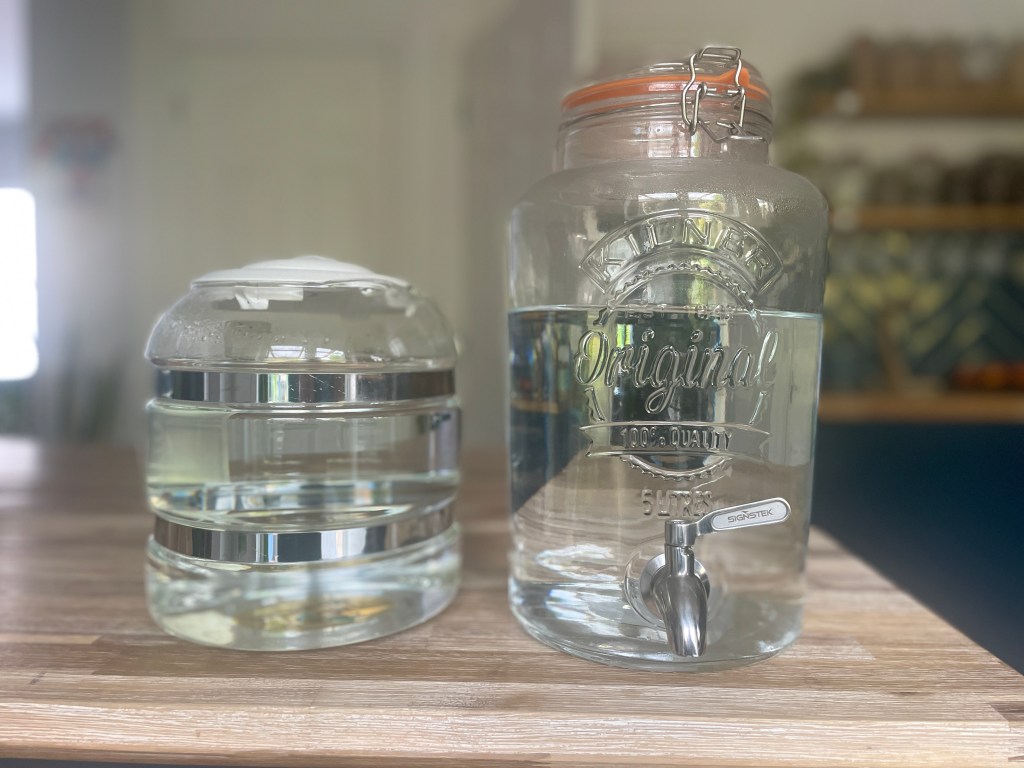
Glass is the preferred storage option for distilled water because it’s inert and won’t interact with the water at all. We store ours in a large Kilner jar with a tap dispenser, which works brilliantly. The tap means you’re not exposing the whole batch to air every time you pour a glass. If our Kilner jar is already full when we finish a fresh batch, it stays in the glass jug that comes with the Megahome distiller until there’s room – we move it across as soon as we can. We also use glass water bottles when we’re out and about.
Exposure to air. Once distilled water is exposed to air, it starts to absorb carbon dioxide, which can very slightly lower its pH over time. It can also pick up airborne contaminants if left open or stored somewhere dusty. This doesn’t make it unsafe to drink, but a sealed container is always better than an open one.
Contamination during use. If you’re dipping cups or unwashed hands into your storage container, you’re introducing bacteria into the water. Distilled water has no minerals or chlorine – the very things that give tap water some natural resistance – so once bacteria are introduced, there’s nothing to inhibit their growth. A container with a tap or a tight-fitting lid is far better than an open jug for this reason.
Light and heat. This one is worth taking seriously. Storing distilled water in direct sunlight or somewhere warm can encourage algae growth – and this has actually happened to us when our Kilner jar was sitting on a windowsill during a warm sunny spell. We could see green algae starting to form along the bottom and around the inside of the tap. It’s not dangerous, but it’s obviously not something you want to drink. A cool, dark spot away from windows is genuinely the best place to keep it.
How long does distilled water last?
If stored properly in a sealed glass container, away from heat and light, distilled water can stay fresh and good to drink for a long time. Commercially bottled distilled water typically carries an expiry of around two to five years, which gives you a rough sense of the shelf life – though again, that’s really about the container degrading over time rather than the water itself spoiling.
For us as a family of four, it has genuinely never gone bad. We make one to two batches a day and go through it constantly, so it’s always fresh. We’ve also kept distilled water for several days with no issues at all, and when we had two Kilner jars on the go we were storing up to a week’s worth at a time without any problems.
If you’re a single person making the occasional batch and leaving it sitting for weeks, the situation is a bit different – but stored properly in glass and kept out of direct sunlight, it holds up well for longer than you might expect.
How to tell if distilled water has gone off
In most normal home use situations, you’re unlikely to encounter distilled water that’s genuinely gone bad. But here’s what to look out for.
Visible algae, mould, or a green tinge. As mentioned above, this can happen if the container has been sitting in sunlight. You’ll typically see green forming along the bottom or around any taps or seals first. If you spot this, discard the water and give the container a thorough clean before refilling. To keep mould and algae at bay in the first place, it’s worth washing out your Kilner jar or storage container every now and then and letting it dry fully before refilling – don’t just keep topping it up indefinitely without giving it a proper clean.
Cloudiness or particles. Fresh distilled water should be completely clear. If it looks cloudy or you can see particles floating in it, something has contaminated it and it’s not worth drinking.
An unusual smell. Fresh distilled water is essentially odourless. A stale or musty smell is a sign something is off and it’s worth replacing the batch.
An off taste. If your water just doesn’t taste as clean and pure as usual and it’s a relatively fresh batch, it’s worth checking the carbon filter in your distiller’s spout before assuming the water is the problem. I can always tell when ours needs replacing because the taste changes – it loses that clean, neutral quality. Swap the filter and it’s back to normal straight away. If the filter is fine and the water has been stored for a while – especially in plastic or somewhere warm – it’s worth making a fresh batch.
Can distilled water go bad enough to make you ill?
Only if it’s been contaminated after distillation – and even then, the risk is low in normal household use. For everyday home use with a clean storage container, this really isn’t something to worry about.
The benefits of drinking distilled water far outweigh the minor storage considerations, and once you have a good routine in place – make a fresh batch, store it in glass, keep it out of the sun – the question of whether it goes bad becomes largely irrelevant.
If you’re unsure about whether distilled water is safe to drink in general, I’ve covered that in detail in my post on whether distilled water is safe to drink.
The best way to store distilled water at home
To keep distilled water fresh and tasting its best, a few simple habits make all the difference:
- Store in a glass container with a sealed lid or tap dispenser
- Keep it in a cool, dark place away from direct sunlight
- Avoid dipping cups or fingers directly into the container
- Make fresh batches regularly rather than storing large volumes for weeks
- Clean your storage container regularly to prevent any buildup
If you’re making your own distilled water at home, you can read more about how to make distilled water and how to clean your water distiller to keep the whole process as clean and fresh as possible.
So does distilled water go bad?
Not really, no. Pure distilled water stored correctly in a clean glass container will stay good for a very long time – potentially indefinitely if kept sealed and away from heat and light.
The things that cause quality to deteriorate are all easy to avoid with a sensible setup. Keep it in glass, keep it sealed, keep it out of the sun, and check your carbon filter if the taste changes unexpectedly.
Do that, and if you’re drinking distilled water regularly like we do, it’s genuinely not something you’ll ever need to worry about.
Discover more from Healthy Vix
Subscribe to get the latest posts sent to your email.