
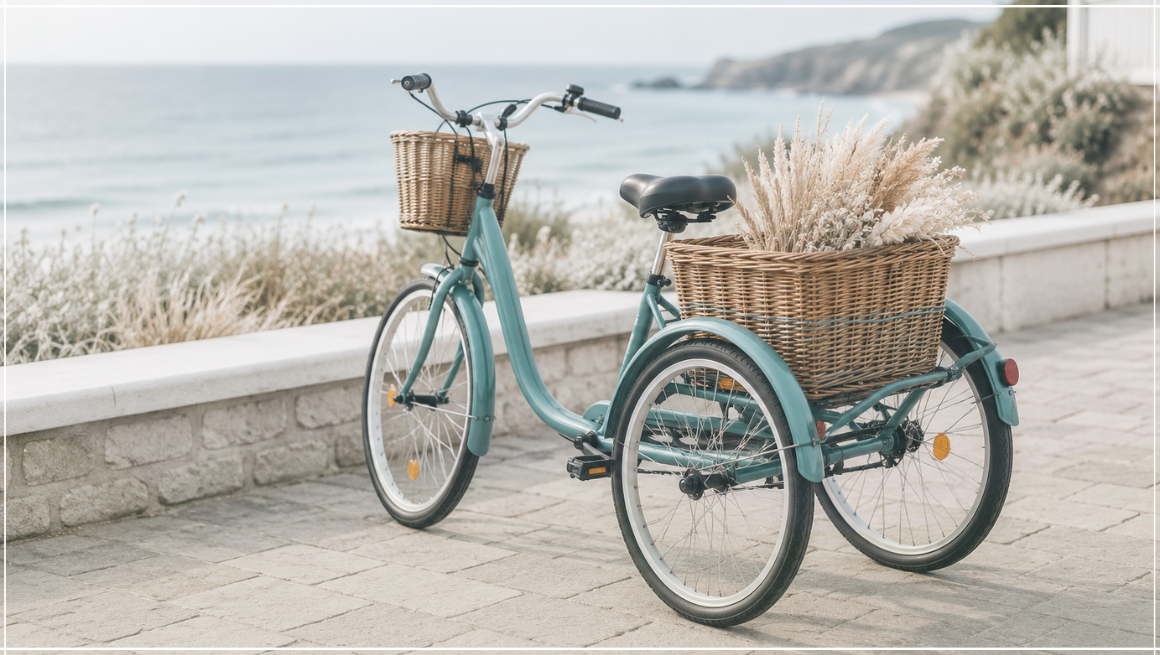
When most people think of tricycles, they picture something for toddlers. But adult tricycles are a genuinely useful and increasingly popular form of transport and exercise – and for many people, they’re actually a better option than a standard bicycle.
If you’re considering one, here’s an honest look at the advantages and disadvantages of adult tricycles, so you can decide whether one is right for you.
Who are adult tricycles for?
Adult tricycles aren’t just for one type of person. They’re used by a wide range of people for very different reasons – commuters looking for an eco-friendly alternative to the car, older adults who want to stay active but don’t feel safe on two wheels, people with disabilities or balance issues who can’t ride a standard bike, and people who simply enjoy a more relaxed, stable ride.
That accessibility is one of the things that makes them worth considering. Standard bikes exclude a lot of people. Adult tricycles don’t.
The advantages of adult tricycles
1. Stability and balance
The most obvious advantage of a tricycle over a bicycle is stability. With three wheels instead of two, there’s no need to balance – the trike stays upright on its own, even when you’re stationary. You can stop at a junction without putting your foot down, and you don’t need to worry about toppling over.
This makes a significant difference for older adults, people with balance conditions like vertigo or dyspraxia, or anyone who has simply lost confidence on two wheels. It opens up cycling to people who might otherwise have ruled it out entirely.
2. Accessibility for more people
Two-thirds of disabled cyclists find riding a tricycle considerably easier than walking. For people with conditions like Developmental Co-ordination Disorder (dyspraxia), Parkinson’s, or other mobility issues, a tricycle can make independent, active transport possible where a standard bike can’t.
For older adults, the same applies. The fear of falling is one of the biggest barriers to cycling later in life – and a tricycle removes that barrier almost entirely. It’s a piece of equipment that supports continued independence and activity for people who need a little more stability.
3. Great for your health
Cycling in any form is excellent low-impact exercise. It’s gentle on the joints compared to running, works the legs, glutes, and core, and gets you outdoors and moving – all of which is good for both physical and mental wellbeing.
For people who struggle with higher-impact exercise, or who are getting back into activity after illness or injury, a tricycle is a particularly good option. The pace is gentle, the stability removes anxiety about falling, and the physical benefits are real.
4. Environmentally friendly
Choosing a tricycle over a car for local journeys – even occasionally – makes a meaningful difference. Tricycles produce no emissions, create no noise pollution, and require no fuel. For short commutes, errands, or leisure rides, they’re one of the most sustainable transport options available.
Electric tricycles take this further still, making longer journeys accessible without the effort, while still producing far fewer emissions than a car.
5. Cargo carrying capacity
Most adult tricycles come with a basket at the front or a cargo bag at the rear, making them genuinely practical for shopping, commuting with a bag, or carrying equipment. Some models can carry significant weight – far more than a standard bike – which makes them useful for people who need to transport things regularly.
This practical advantage is one of the reasons tricycles are popular for weekly shopping runs or local errands, particularly for older adults who might otherwise struggle to carry bags on foot.
6. A growing community
There’s a surprisingly active tricycle community in the UK, with organisations like the Tricycle Association providing resources, events, and a place to connect with other riders. Social media groups dedicated to tricycling are well established too, making it easy to get advice, share routes, and meet people with the same interest.
If you’re new to tricycles and want support getting started, that community is genuinely useful.
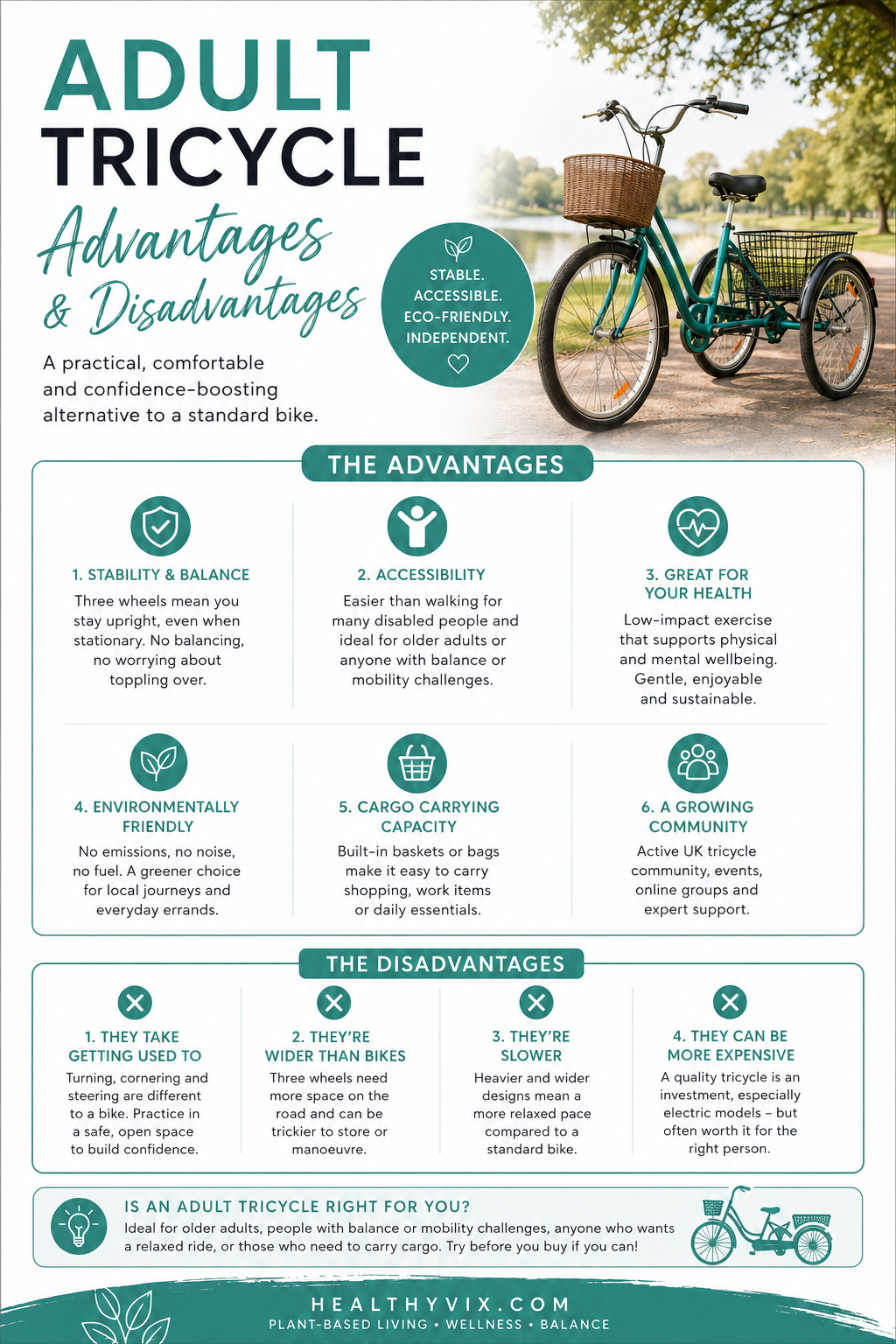
The disadvantages of adult tricycles
No honest guide to adult tricycles would be complete without covering the downsides. There are some real ones worth knowing about before you buy.
1. They take getting used to
Riding a tricycle is not the same as riding a bike, and it can take some adjustment. Corners need to be taken wider, the turning circle is larger, and the instinct to lean into bends – which works on a bike – can actually cause a trike to tip on a sharp corner. You steer a tricycle rather than lean it.
Most people find it clicks fairly quickly, but it’s worth practising in a large open space before taking one onto the road for the first time.
2. They’re wider than bikes
Three wheels take up more space than two, which means tricycles are wider on the road and harder to manoeuvre in tight spaces. Filtering through traffic, navigating narrow paths, or storing the trike at home all require a bit more planning. Folding tricycle models help with storage, but they’re an additional cost.
3. They’re slower
Tricycles are generally slower than bicycles. The additional weight, wider profile, and different geometry all contribute to a more leisurely pace. If speed matters to you, a standard bike is the better choice. But for most tricycle riders, the pace is actually part of the appeal – it’s about the ride, not the race.
4. They can be more expensive
A decent adult tricycle costs more than an entry-level bicycle, and quality electric tricycles can be a significant investment. That said, for the right person – particularly someone for whom a standard bike simply isn’t a viable option – the cost is often well worth it.
Is an adult tricycle right for you?
If you want a stable, accessible, eco-friendly way to stay active and get around, an adult tricycle is well worth considering. They’re particularly well suited to older adults, people with balance or mobility challenges, anyone who wants a more relaxed cycling experience, and people who need to carry cargo regularly.
If speed, agility, and a lightweight ride are your priorities, a standard bicycle is probably the better fit.
The best way to decide is to try one. Many specialist cycle shops stock adult tricycles and will let you take one for a test ride – which is the only way to really know whether it suits you.
If cycling in general is something you’re looking to do more of for your health and wellbeing, my post on how walking and cycling can keep you active is worth a read, and you might also find these tips for staying fit on holiday useful too.
Discover more from Healthy Vix
Subscribe to get the latest posts sent to your email.